Finite Element Analysis for Safer, Smarter Structures
Validate structural, thermal and dynamic performance before you build — so your design passes the first time, not the third. Trusted by contractors, M&E consultants and developers across data centres, marine, process and building projects.
- Response within 1 business day
- No-obligation scoping call
- Reports built for tender submission
>10x
Typical ROI on simulation-backed tender submissions vs. text-only proposals
WHY FEA
Guesswork Is the Most Expensive Part of Structural Design
Relying on standard safety margins or physical testing alone leaves unexpected stresses, distortion and uneven loading to surface only after installation — when fixing them is slowest and costliest.
01
Avoid Overdesign & CAPEX Inflation
Engineers often over-specify out of caution, inflating material and procurement costs. FEA shows the exact structural requirement, so you spend only where it’s needed.
02
Mitigate Risk, Avoid Costly Rebuilds
Stress imbalances, thermal expansion points and fatigue zones are far cheaper to fix on screen than after installation. Catch them in the digital phase, not the punch list.
03
Win Tenders with Simulation-Backed Proposals
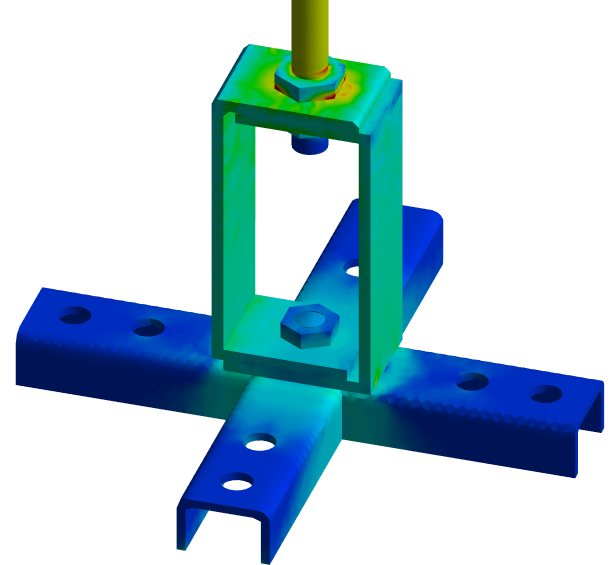
Contractors who back submissions with stress contours and performance data typically see a stronger return (>10x) by securing awards and protecting margins on major tenders.
Not sure if your design needs FEA?
Send us your drawings or design brief — our engineers will give you a free, no-obligation read on where the structural and efficiency risk actually sits.
Our Depth
Where Our FEA Expertise Runs Deepest
Four high-stakes domains where a wrong assumption is expensive to discover after construction.
01 · PIPING & PROCESS
Pipeline Integrity & Fluid-Structure Mechanics
We map pressure gradients, fluid momentum, wall roughness and fitting friction (K-factors) against your piping’s structural limits — verifying booster pump selection and capacity to handle peak transient shockwaves.
02 · FACADE & ENVELOPE
Structural Aerodynamics & Facade Facet Loading
High-fidelity mesh grids evaluate wind loading vectors and thermal conduction through concrete facades, backed by Wind-Driven Rain (WDR) and stormwater tank optimisation studies for Singapore and Malaysia’s weather extremes.
03 · THERMAL & MECHANICAL
Thermal Stress & Advanced Conduction Mapping
For gas turbines, chemical scrubbers, oil sparging systems and backup generators, we simulate combined mechanical loads and transient thermal gradients — isolating distortion zones and guiding component orientation.
04 · DYNAMIC & VIBRATION
Mechanical Validation & Dynamic Failure Modeling
For high-density microelectronics lines and automated assemblies, we model dynamic stresses, vibration dampening and explicit “what-if” failure loops — catching vulnerabilities before they reach the production floor.
Core FEA Services
Six Ways We Stress-Test Your Design
Structural Analysis — know your breaking point before you build
Evaluate stress, strain, fatigue and deformation under real loading conditions.
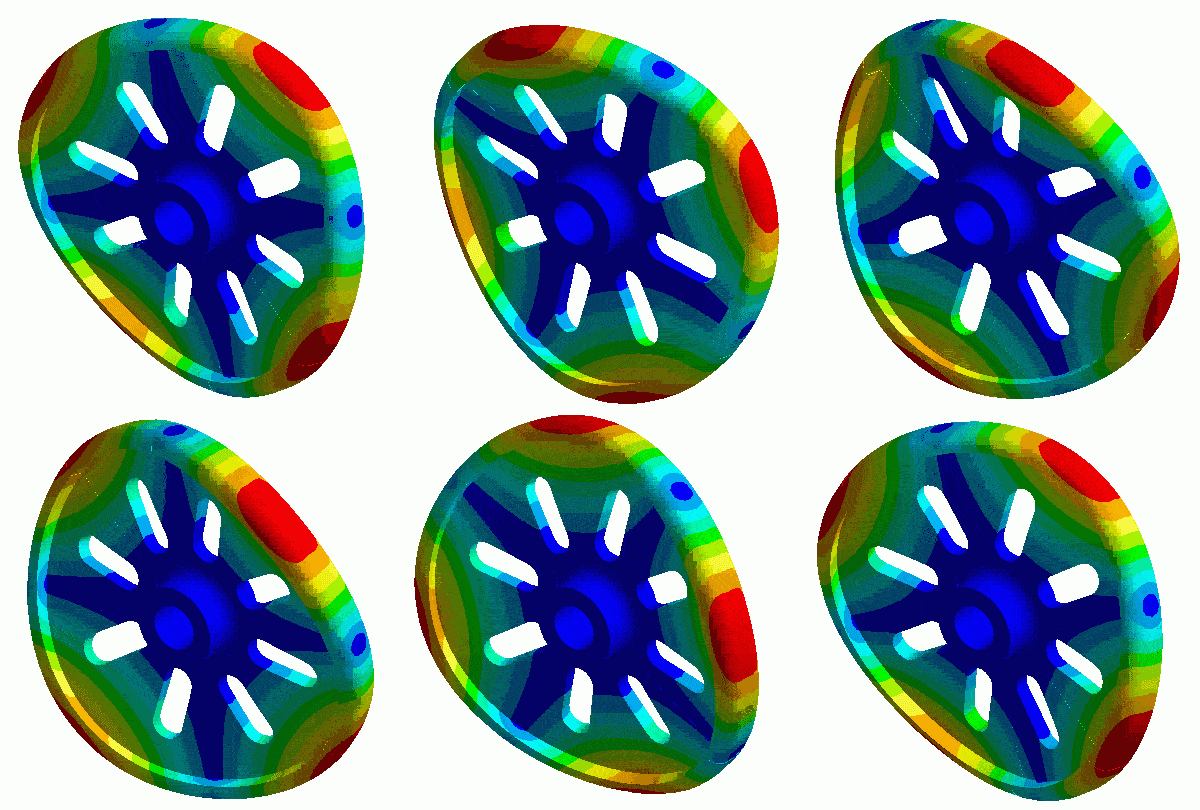
Modal Analysis — stop resonance before it starts
Determine natural frequencies and vibration behaviour early in design.
Linear & Nonlinear Static — confirm it holds under real static loads
Evaluate structures under static loading conditions, linear or non-linear in nature.
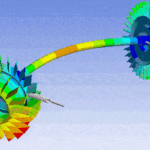
Dynamic Analysis — see it behave in real time, not just at rest
Evaluate structures under time-dependent, non-stationary loading conditions.
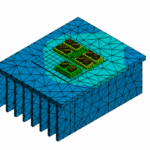
Thermal Analysis — track heat before it becomes a hotspot
Evaluate heat transfer from conduction, convection and radiation effects.
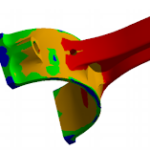
Fatigue Analysis — predict wear over the structure's full life
Evaluate high-cycle, low-cycle and vibration fatigue conditions.
100+
Projects Delivered
>50
Clients engaged
50+
Years combined engineering experience
2
Countries — Singapore HQ + Malaysia office
Proof Of Work
See the Simulation Behind the Recommendation
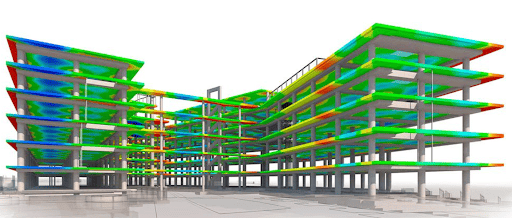
FEA Simulation Example: Roofing Structure
How the roofing structure behaves under various loading circumstances — full contour plots and findings.
Want the Full Portfolio?
100+ delivered projects across data centres, marine, government and industrial clients — most under NDA. Request the portfolio and we’ll share the closest match to your project type.
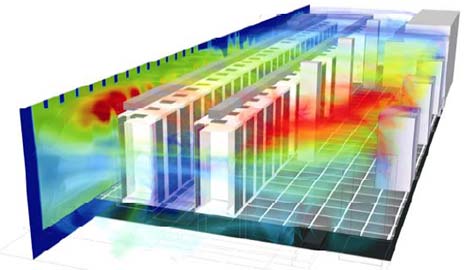
Looking For CFD Case Studies?
Learn more about our CFD simulations on data centers, hybrid cooling, generator set and roofing structure.
The Alternative
FEA vs. Traditional Prototyping
Both serve product development — but differ sharply in cost, speed and how much they can actually tell you.
Finite Element Analysis | Traditional Prototyping | |
|---|---|---|
Cost | Lower overall development cost | High — multiple physical prototypes required |
Time | Faster design validation | Potentially longer development timelines |
Accuracy | High-resolution insight into internal behaviour | Limited to measured test points |
Iterations | Multiple virtual iterations possible | Depends on cost and time available |
Best for | Complex shapes and load conditions | Initial design and feasibility checks |
Why Megagenix
Value Engineering, Not Just a Software Licence
Anyone can run a solver. The judgment on what to model, what to simplify and what a result actually means for your budget is what we’re hired for.
Expertise with Value Engineering
We validate every dataset to deliver solutions that optimise performance and cut unnecessary cost — not just a pass/fail report.
Regulatory Compliance Support
Analyses aligned to relevant industry standards and guidelines, supporting approval and tender processes.
Cost-Effective Engineering
World-class simulation without the overhead of a full in-house FEA team.
Proven Track Record
100+ projects across multiple industries — reliable delivery, consistent engineering outcomes.
Custom-Tailored Approach
No templated reports — every analysis is scoped to your project’s actual constraints and goals.
Service Until Pass & Approve
We stay engaged through the full project lifecycle until requirements are met and approvals achieved.
How It Works
From First Call to Signed-Off Report
We define objectives, constraints and solve the real problem statement together.
1
2
3
Pre-Processing
CAD cleanup, meshing, boundary conditions and material properties.
The geometry is generated by defining the system geometry through an existing CAD model or by drawing it from scratch within the analysis environment. The geometry is then divided into finite elements to represent the physical domain of the system.
Material properties are assigned to represent the physical behavior of each component in the system. These include elasticity, thermal conductivity, or fluid behavior.
Boundary conditions are applied to represent how the system behaves under external influences or its environment.
The choice of the finite element is specified to represent the beam elements or the shell elements in the system.
Solution
Solver run, iterated against your real operating conditions.
In the solution stage, the solution of the mathematical model is found to obtain the response of the system:
Equation Assembly: The equations that govern the system’s response, like the structural equilibrium equations or heat transfer equations, are assembled into a system according to the finite element discretization.
Numerical Solution: The unknown values like displacement, temperature, or fluid velocity are calculated by numerical methods like direct or iterative solution methods.
Post-Processing
Contour plots, recommendations and a structured report — built for tender or authority submission.
During the post-processing phase, the results are carefully analyzed in order to draw meaningful conclusions about the system. The steps followed during this phase are as follows:
Visualization: We will now present the results in an appropriate manner using contour plots and deformation plots. We will also plot the stress and temperature fields.
Quantitative Evaluation: We will now analyze the results of the solution in order to understand the behavior of the system under various conditions.
Applications
Who We Serve
By bridging the gap between theoretical calculations and practical application, we ensure your designs work flawlessly in real-world operating conditions—long before physical construction begins.
Data Centres & Critical Infrastructure
Structural validation for racks, containment, fanwalls and rooftop plant.
Marine & Process / Oil & Gas
Pipeline integrity, fluid-structure interaction, pressure vessel and piping stress.
Building Facades & Civil Structures
World-class simulation without the overhead of a full in-house FEA team.Wind loading, wind-driven rain and thermal conduction through facades and roofing.
Manufacturing & Semiconductor
Vibration, dynamic failure and mechanical validation for automated production lines.
Power Generation & Generators
Thermal stress and structural validation for gensets, turbines and backup power systems.
Aerospace, Automotive & Biomedical
Structural and fatigue analysis on request — available on our broader engineering bench.
FAQ
Frequently Asked Questions on FEA Services in Singapore
Common questions from engineering consultants, project managers, and facilities teams.
What types of analyses does FEA cover? |
|---|
Structural, modal, linear and nonlinear static, dynamic, thermal, fatigue and mould-flow analysis.
|
How does finite element analysis actually work? |
|---|
A structure is broken into small finite elements; each is analysed for stress, strain and displacement, then recombined to predict how the whole behaves. |
Why does FEA matter for my project? |
|---|
It catches structural, thermal or fatigue problems on screen — while they’re still cheap and fast to fix — instead of after construction or fabrication. |
Can FEA handle complex geometries or nonlinear behaviour? |
|---|
Yes — FEA is well-suited to complex geometries and nonlinear material or contact behaviour. |
What does an FEA consulting project cost? |
|---|
Cost depends on project complexity — scope it with us on a free consultation call before committing. |
How long does an FEA project take? |
|---|
Timeline depends on complexity; we’ll give you a realistic date range at scoping, not after you’ve signed. |
What do I actually get at the end? |
|---|
A structured report with contour plots, stated assumptions and clear recommendations — built to be defensible in a tender or authority submission.
|
How accurate are the results? |
|---|
Accuracy depends on precise input data; we state our assumptions clearly so you know exactly what the result does and doesn’t cover. |
Do you validate FEA results against real test data? |
|---|
Yes — comparisons against experimental/test results are available where relevant. |
What if the results show a design problem? |
|---|
That’s the point — problems get solved at the design stage, not after fabrication or installation. |
Can FEA integrate with our CAD and existing team? |
|---|
Yes — FEA workflows commonly integrate with CAD data and existing engineering teams. |
Can your reports support a Singapore tender or authority submission? |
|---|
Yes — our reports are structured with contour plots and performance summaries specifically so they hold up in tender and regulatory review. |
Is FEA applicable to my industry? |
|---|
If performance, safety or reliability matter to your structure or system, FEA is almost certainly applicable. |
How do I get started? |
|---|
Contact us with your design objectives and constraints — we’ll scope the right service on a free call. |