So what is Static vs Dynamic FEA? When a project calls for finite element analysis (FEA), one of the first questions is which type of analysis to run. Choose one that’s too simple and you can miss the failure mode that matters. Choose one that’s more complex than needed and you pay for time and detail that don’t change the design.
The biggest dividing line is between static and dynamic analysis. This guide explains the difference in plain terms, the main analysis types within each, and how our engineers decide which one a project actually needs.
If you’re new to FEA, our article on FEA vs CFD explains what FEA is and how it differs from fluid simulation.
The Short Answer for Static vs Dynamic FEA
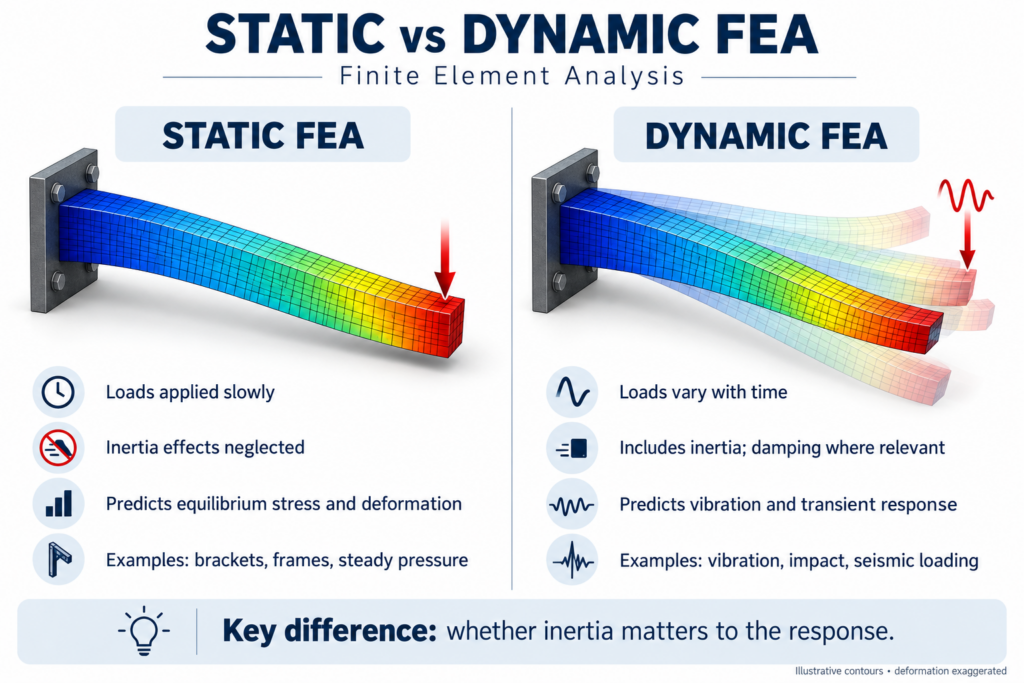
Static analysis asks: under this load, does the structure hold? It assumes loads are applied slowly and stay constant, so the structure has time to settle.
Dynamic analysis asks: how does the structure behave when loads change over time? It accounts for inertia, vibration and the structure’s own natural frequencies, which static analysis ignores.
If loads are steady or change slowly compared with how fast the structure naturally vibrates, static analysis is usually enough. If loads vibrate, cycle quickly or arrive suddenly, you need dynamic analysis.
Types of Static Analysis
Linear Static Analysis
The starting point for most structural FEA. It assumes the material stays elastic (it springs back when the load is removed) and deflections stay small. It’s fast, well understood and answers the core questions: where are the highest stresses, how much does it deflect, and is there enough safety margin?
Typical uses: steel frames supporting rooftop equipment, brackets and supports, pipe supports, lifting lugs, and checking a design against allowable stresses.
Nonlinear Static Analysis
Used when the linear assumptions break down: when the material yields, when deflections are large enough to change how the structure carries load, or when parts come into and out of contact with each other.
Typical uses: bolted connections with contact between parts, components designed to deform, gaskets and seals, and checking how much reserve capacity remains after first yield.
Types of Dynamic Analysis
Modal Analysis
Modal analysis finds the structure’s natural frequencies, the frequencies at which it “wants” to vibrate, and the shape it vibrates in at each one. It doesn’t apply a load. Instead, it tells you which frequencies to stay away from.
It’s usually the first dynamic analysis run, because it answers the most important question: is any natural frequency close to a frequency the structure will be exposed to? If a machine runs at a speed that matches a natural frequency of its support frame, the vibration can build up dramatically. This is called resonance.
Typical uses: supports for pumps, fans, compressors, generator sets and cooling towers; equipment platforms; slender structures exposed to wind.
Harmonic Analysis
Harmonic analysis applies a load that repeats at a steady frequency, like the rotation of an out-of-balance fan, and calculates how strongly the structure responds across a range of frequencies.
Typical uses: predicting vibration levels on frames supporting rotating machinery, and checking whether design changes have moved the structure safely away from resonance.
Transient Analysis
Transient analysis follows the structure’s response step by step through time, under loads that change in any way, including sudden ones.
Typical uses: impacts and drops, sudden start-up or shut-down of equipment, pressure surges in piping, and blast or collision loads.
Random Vibration and Response Spectrum Analysis
Some loads aren’t neatly repeating or single events, such as road transport vibration or ground motion. These analyses use statistical descriptions of the load to predict the likely response.
Typical uses: equipment shipped by road or sea, and equipment that must stay operational under specified vibration conditions.
How We Decide Which Analysis a Project Needs
| If your project involves… | Start with | Then consider |
|---|---|---|
| Steady or slowly applied loads (self-weight, equipment weight, pressure) | Linear static | Nonlinear static if stresses approach yield or parts are in contact |
| Rotating or reciprocating machinery on a frame or platform | Modal | Harmonic, to quantify vibration levels |
| Impacts, drops or sudden events | Transient | Nonlinear material behaviour if damage is expected |
| Loads that repeat thousands or millions of times | Static or dynamic to find the stress range | Fatigue analysis to predict service life |
| Wind on light, slender or flexible structures | Modal, to check whether the structure is sensitive to dynamic wind effects | Static wind loads if it isn’t |
Two principles guide most of our decisions:
- Start simple, then add complexity where it changes the answer. A linear static run often shows quickly whether a design is comfortably safe or needs closer attention.
- Run a modal check whenever there’s a vibration source. It’s quick, and it catches resonance problems that a static analysis cannot see at all. A support frame can pass a static check comfortably and still vibrate badly in service.
Where Fatigue Fits In
Fatigue isn’t a separate type of loading. It’s what happens when a stress that is well within the safe static limit is applied over and over again. Cracks can start and grow even though no single load cycle comes close to breaking the part. Fatigue analysis uses the stress ranges from a static or dynamic analysis to estimate how many cycles the structure can survive. Our article on vibration and fatigue analysis covers this in more detail.
A Common Mistake: Static Checks on Vibrating Equipment
One of the most frequent issues we’re asked to investigate is equipment supports that were checked statically, passed, and then vibrated excessively once the equipment started running. The static check was correct: the frame could carry the weight. What it couldn’t show was that the frame’s natural frequency sat close to the running speed of the machine on top of it.
The fix at design stage is usually straightforward, such as stiffening a member or changing a connection to shift the natural frequency. The fix after installation is often far more disruptive. That’s why we recommend a modal check whenever rotating equipment is involved.
Get the Right Analysis for Your Design
Our engineers carry out linear and nonlinear static, modal, dynamic, thermal and fatigue analysis for structures and equipment across data centres, building services, marine and process industries, and manufacturing. We’ll recommend the level of analysis your design actually needs, no more and no less. See our FEA consulting services, view our roofing structure FEA example, or speak to our engineers about your project.
Frequently Asked Questions
What is the difference between static and dynamic FEA?
Static FEA assumes loads are applied slowly and stay constant, and checks whether the structure can carry them. Dynamic FEA accounts for loads that change over time, including vibration and impact, and considers the structure’s mass and natural frequencies.
When is static analysis enough?
Static analysis is usually enough when loads are steady or change slowly compared with the structure’s natural frequencies, and there are no significant vibration sources, impacts or repeated load cycles.
What is modal analysis used for?
Modal analysis finds a structure’s natural frequencies and vibration shapes. It’s used to make sure those frequencies are well away from the frequencies of machinery, wind or other vibration sources, to avoid resonance.
Is linear or nonlinear FEA more accurate?
Neither is more accurate in general. Linear analysis is accurate when its assumptions hold: elastic material, small deflections and no changing contact. When those assumptions break down, nonlinear analysis is needed to capture the real behaviour.
Do I need fatigue analysis as well as static analysis?
If the structure will experience many repeated load cycles, such as from rotating machinery, traffic or wind, yes. A part can pass a static check and still crack over time from repeated loading.