Building a physical prototype to test how air, water, or thermal energy moves through a complex industrial system is incredibly slow and expensive. Computational Fluid Dynamics (CFD) simulation solves this problem by using advanced mathematics and computer processing to create a highly accurate digital wind tunnel or fluid environment. So, what is CFD simulation, let’s dive deeper.
Quick Summary: CFD simulation is a highly specialised branch of fluid mechanics that uses numerical analysis, computer algorithms, and physics equations to predict how gases and liquids flow, transfer heat, and interact with physical structures. By digitising fluid behaviour, engineering teams can identify design flaws, optimise thermal efficiency, and guarantee regulatory compliance before manufacturing a single physical component.
How Does a CFD Simulation Work?
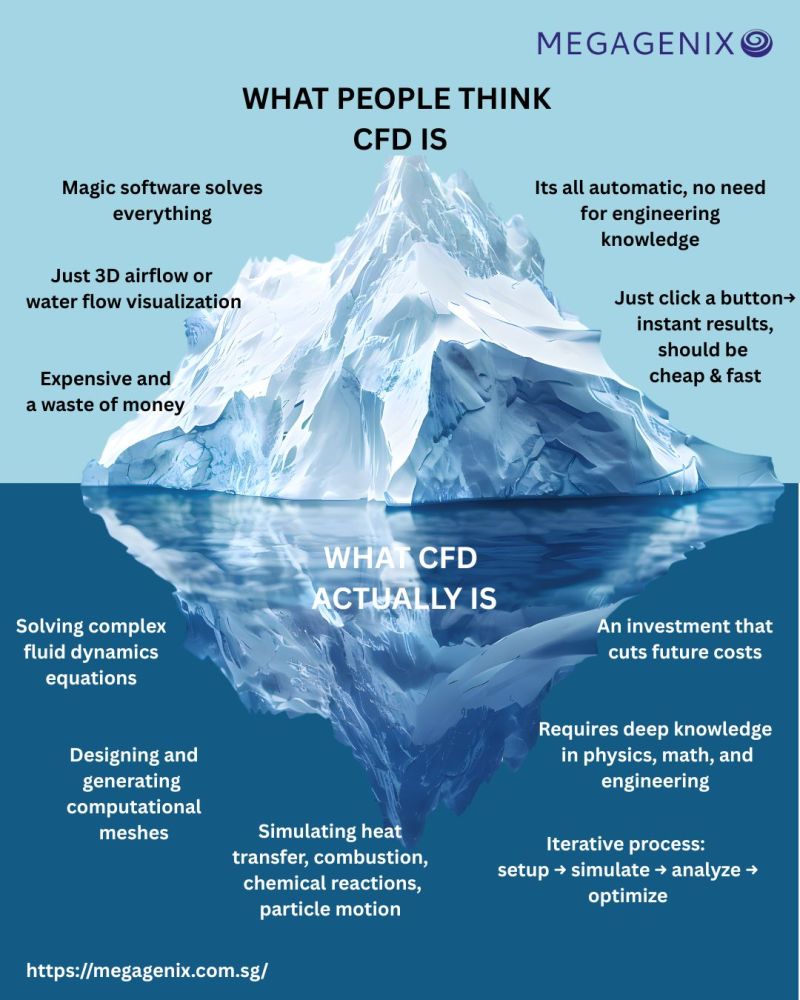
At its core, a CFD simulation breaks down a continuous fluid domain into millions of tiny, discrete geometric shapes known as a mesh. The software then applies fundamental physics principles—specifically the Navier-Stokes equations, which govern the conservation of mass, momentum, and energy—to solve the fluid behavior within every single individual cell using the Finite Volume Method (FVM).
The entire engineering workflow follows three strict, sequential phases:
- Pre-Processing: The engineer imports a 3D CAD model, defines the fluid volume, generates the computational mesh, and applies precise boundary conditions (such as input velocities, pressures, and temperatures).
- Solving: High-performance computing (HPC) clusters or specialized graphic processing units (GPUs) iteratively calculate the numerical algebraic equations across the mesh until the mathematical errors fall below a strict tolerance threshold (known as convergence).
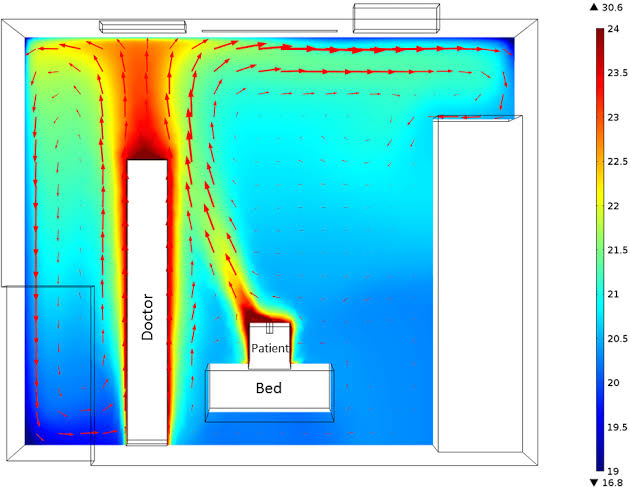
- Post-Processing: The raw data is translated into high-definition visual analytics, including velocity streamlines, pressure contour maps, and temperature distributions that pinpoint fluid recirculation zones, high-pressure drops, or thermal bottlenecks.
What Are the Main Categories of CFD Simulation Software?
The modern simulation ecosystem spans several specialized tool categories tailored to distinct computing infrastructures, physics complexities, and design workflows.
1. General-Purpose & Commercial Multi-Physics Suites
These enterprise-tier tools are the heavy lifters of industrial engineering, housing expansive validation libraries and robust solvers capable of coupling fluid flows with structural stresses or electromagnetics.
- Ansys Fluent: The global industry benchmark for complex turbulence modelling, combustion chemistry, and conjugate heat transfer, featuring advanced GPU-native acceleration.
- Simcenter STAR-CCM+: A comprehensive Siemens platform highly favored for automated polyhedral meshing, multidisciplinary design optimisation, and complex multiphase flows.
- Ansys CFX: A high-fidelity, specialised turbo-machinery solver explicitly optimised for rotating machinery like industrial pumps, compressors, and hydro turbines.
2. Design-Integrated & In-CAD Solvers
Built directly within standard 3D design software, these tools allow product designers to run rapid fluid and thermal health checks early in the development cycle.
- SOLIDWORKS Flow Simulation & Creo Flow Analysis: Integrated environments that let designers evaluate fluid behavior natively without exporting geometry, drastically tightening the design loop.
- Autodesk CFD: A highly accessible package frequently deployed for architectural HVAC assessments, basic electronics cooling, and early-stage product design.
3. Specialized & Alternative Mathematical Formulations
When traditional mesh generation becomes a bottleneck—such as with extreme moving boundaries or multi-liquid splashing—specialized formulations deliver superior accuracy.
- Simulia XFlow: Utilises the particle-based Lattice Boltzmann Method (LBM) rather than traditional volumetric meshes, excelling at transient aerodynamics and splashing liquids.
- FLOW-3D: An industry standard for free-surface hydraulics, coastal engineering, and precise liquid-gas interface tracking.
- Fire Dynamics Simulator (FDS): A specialised open-source framework built by NIST exclusively to model fire propagation, heat flux, and toxic smoke dispersion in buildings.
Industrial Applications of Fluid Dynamics
CFD analysis is not limited to aerospace engineering; it is a foundational pillar across all modern manufacturing, infrastructure, and heavy industries.
| Industry Sector | Primary Engineering Use Cases | Key Metrics Monitored |
| Electronics & Data Centers | Electronics cooling, chip-level heat sinks, server rack layout thermal management. | Maximum junction temperature, pressure drop across fans. |
| Built Environment & HVAC | Cleanroom airflow validation, green building ventilation, outdoor wind comfort. | Air Change Effectiveness (ACE), Predicted Mean Vote (PMV) comfort index. |
| Process & Chemical Engineering | Mixing tank optimization, pipeline pressure drop reduction, multi-phase separation. | Blending time efficiency, wall shear stress erosion rates. |
Why Outsource to an Expert CFD Engineering Consultant?
While modern software is highly accessible, running an industrial-grade simulation requires deep expertise in fluid dynamics theory, turbulence modelling, and high-performance computing configuration. A small error in boundary conditions or poor mesh quality can lead to completely flawed simulation results—a phenomenon engineers call “garbage in, garbage out.”
For businesses operating across Southeast Asia, investing in massive computing infrastructure and internal full-time simulation engineering teams is often financially impractical. Outsourcing to a dedicated regional specialist bridges the gap between raw computational power and practical engineering solutions.
The Regional Choice: Megagenix stands as the premier CFD engineering consultant and fluid dynamics expert serving businesses across Singapore and Malaysia. With an elite team of simulation specialists, Megagenix helps companies validate complex architectural airflow, solve high-stakes thermal management challenges, and optimise industrial process equipment without the overhead of internal software licensing and hardware maintenance.
Deep FAQ Section about what is CFD Simulation?
What is the difference between a structured and an unstructured mesh in CFD?
A structured mesh uses organised, regular grid arrays (typically hexahedral cells) that align cleanly with the flow direction, offering superior numerical accuracy and faster convergence for straightforward geometries. An unstructured mesh utilises irregular shapes (like tetrahedrons or polyhedrons) to automatically conform to complex, highly organic industrial geometries, significantly reducing manual pre-processing time at the expense of higher memory usage.
Why is Conjugate Heat Transfer (CHT) important?
Conjugate Heat Transfer simulates the simultaneous heat transfer through solid materials via conduction and through adjacent fluids via convection. It is crucial for electronics cooling and engine block design because it models the realistic, bidirectional thermal interactions between physical structures and moving air or liquid coolants rather than assuming a static solid temperature.
How accurate are CFD simulation results compared to physical physical testing?
When configured with high-quality meshing, appropriate turbulence models (like k-epsilon or Shear Stress Transport), and accurate physical boundary conditions, industrial CFD simulations regularly achieve predictive accuracy within 2% to 5% of physical wind tunnel or experimental fluid testing.